


1. Why Intranet HTTPS Needs a Dedicated Automation Solution
Internal Web systems carry more important business data and sensitive information. Deploying firewalls at network boundaries or continuing to use unencrypted HTTP does not adequately protect data in transit across an intranet.
Organizations commonly face several challenges when deploying intranet HTTPS:
- Public CAs cannot issue publicly trusted certificates for private IP addresses, internal domain names, or internal hostnames for use within an organization.
- An enterprise CA can address certificate issuance, but the organization must still build and maintain the CA infrastructure and manage key protection, cryptographic upgrade, issuance, renewal, revocation, and trust distribution.
- Internal Web systems are distributed across departments, data centers, and branch offices. Installing, renewing, and configuring certificates and client trust one system or device at a time creates significant deployment and operational overhead.
- As organizations prepare for post-quantum cryptography, intranet HTTPS infrastructure must also consider how to support traditional and post-quantum algorithms together.
Zotrus HTTPS Automation Gateway (Intranet Edition) consolidates MiniCA-based certificate self-supply, HSM-protected sub-CA keys, HTTPS cryptographic processing, traffic forwarding, and Web protection in a dedicated gateway. Together with pre-established ZT Browser trust, it helps organizations deploy intranet HTTPS and advance cryptographic modernization with lower implementation and operational overhead.
2. Product Overview
Zotrus HTTPS Automation Gateway (hereinafter referred to as Zotrus Gateway) is an innovative product that has obtained China Commercial Cryptography Product Certification. It enables HTTPS encryption for Internet-facing websites and web systems through automated deployment without requiring modifications to existing applications or infrastructure. To automatically obtain and configure SSL/TLS certificates for customer websites, the Gateway connects to the Zotrus Cloud SSL Service. Therefore, the Internet Edition is designed for websites and web systems accessible from the Internet and is not suitable for isolated intranet environments without Internet connectivity.
However, intranet environments also require HTTPS encryption and automated certificate management to protect internal web traffic. To address this need, Zotrus Technology has developed a dedicated edition of the HTTPS Automation Gateway for intranet deployment. Based on the same core technology, Zotrus HTTPS Automation Gateway (Intranet Edition) or named as Zotrus Intranet HTTPS Automation Gateway, enables automated HTTPS certificate management and encryption entirely within an intranet environment, without relying on external cloud services.
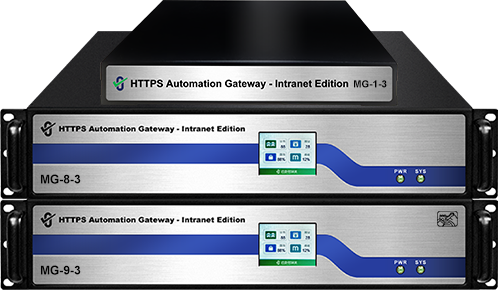
Zotrus HTTPS Automation Gateway (Intranet Edition) is a dedicated HTTPS automation and security appliance for intranet Web systems used by government agencies, financial institutions, and medium-to-large enterprises. It integrates a MiniCA and an embedded PCIe HSM that protects the SubCA private keys, enabling autonomous issuance and management of dual RSA OV and SM2 OV certificates within the local network. The Organization (O) field in both certificate types is set to the deploying organization's name.
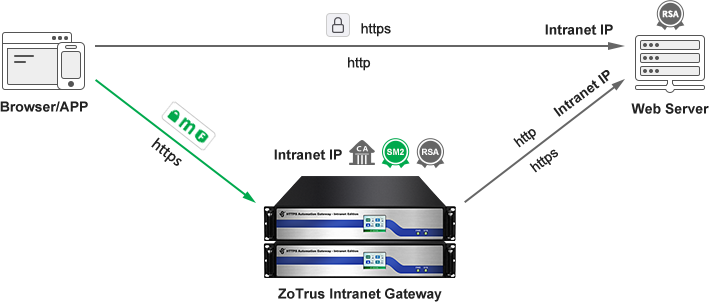
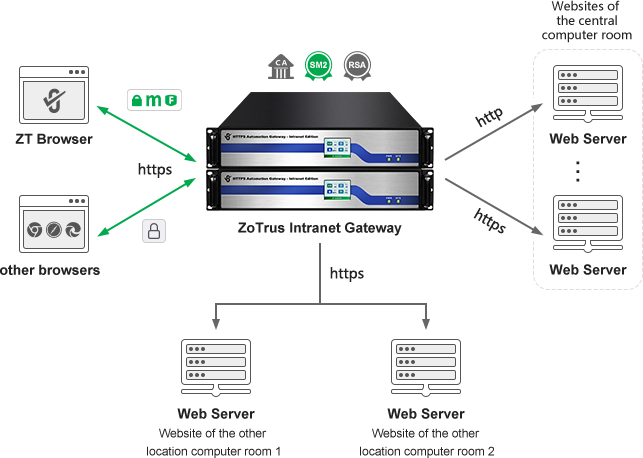
Deployed between users and existing Web servers, the gateway centrally handles HTTPS encryption/decryption and traffic forwarding. The original Web servers do not need to install the server certificates issued by the gateway directly, nor do they need to be upgraded to SM2-capable server software solely to enable gateway-side HTTPS encryption. Actual deployment must be configured and validated according to the existing network topology, traffic paths, application protocols, and security policies.
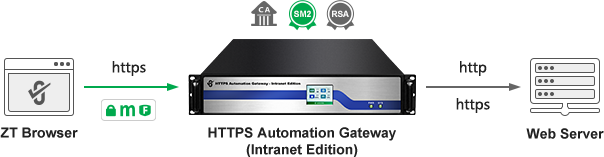
The Intranet Edition provides certificate self-sufficiency: it can issue and manage intranet certificates without an Internet connection and without relying on recurring external CA services for internal server certificates. The five-year deployment package removes the need for repeated purchases of individual intranet server certificates. Models are differentiated primarily by supported website capacity and CPU capacity for processing HTTPS traffic.
3. Built-in MiniCA, Hardware-Protected Keys, and Pre-established Intranet Trust
3.1 Built-in MiniCA: Automated RSA OV + SM2 OV Certificates
The gateway integrates a MiniCA to issue and manage RSA OV and SM2 OV server certificates locally for intranet websites. The Organization (O) field in both certificate types is set to the deploying organization's name, providing consistent organizational identity across the two cryptographic algorithms. The gateway supports certificate renewal and revocation management for intranet IP addresses, internal domain names, and hostnames.
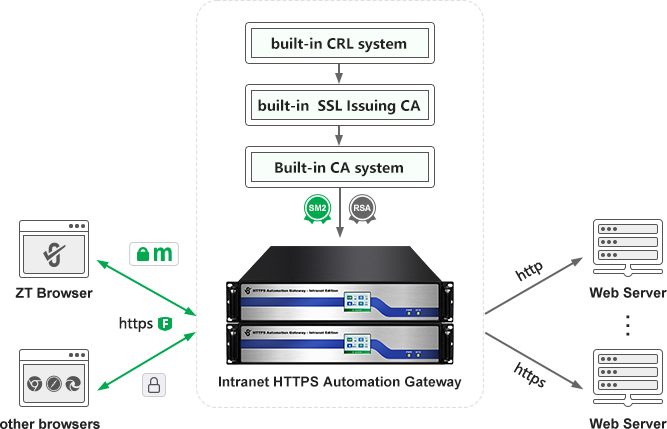
RSA and SM2 certificates serve different client cryptographic capabilities. Clients that support SM2 can use SM2 connections; clients that do not support SM2 can use RSA according to gateway configuration and protocol negotiation. Algorithm selection depends on client capabilities, server configuration, and negotiation.
3.2 Hardware Protection for SubCA Private Keys
The private keys of the gateway's built-in SubCA are protected by an embedded PCIe HSM. Critical CA cryptographic operations are performed within the hardware security boundary, reducing exposure of sensitive CA private keys.
The Gateway does not include a self-signed root CA by default. Its SubCA is issued by an intranet root CA trusted by ZT Browser, ensuring that all intranet SSL certificates are automatically incorporated into the Zotrus Intranet Root Trust System. Alternatively, the SubCA certificate can be issued by the enterprise's existing corporate root CA. A self-signed root CA can also be established upon customer request.
3.3 A Pre-established Trust Chain for Intranet HTTPS
The gateway's built-in SubCA issued SSL certificate is already trusted by ZT Browser. The gateway uses this SubCA to automatically issue and manage intranet TLS/SSL certificates. ZT Browser can validate certificates that meet the applicable chain, usage, and other validation requirements, without requiring organizations to manually deploy the corresponding Root CA certificate to every device running ZT Browser.
The certificate chains for RSA-based and SM2-based Intranet SSL certificates are illustrated below.
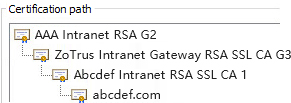
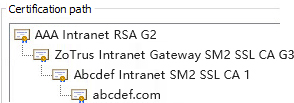
In addition, to accommodate specific use cases where an organization's intranet uses public IP addresses and public domain names that cannot be validated, the Zotrus Intranet Gateway can provision two additional SubCAs (SM2 and RSA), each issued by a separate self-signed root CA (Intranet SM2 Root and Intranet RSA Root) that is not trusted by ZT Browser. These SubCAs are used to automatically issue intranet SSL certificates bound to public IP addresses and public domain names for which domain or IP address control cannot be validated.
The certificate chains for RSA-based and SM2-based Intranet SSL certificates are illustrated below.
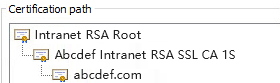
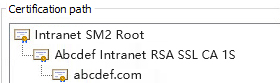
This pre-established trust relationship significantly simplifies the large-scale deployment of intranet HTTPS. However, the pre-established trust in ZT Browser addresses only the trust deployment within ZT Browser; it does not mean that all other browsers and operating systems will automatically trust the intranet certificate chains. Organizations must deploy the intranet root certificates themselves in accordance with their endpoint management policies. These include the two intranet root certificates trusted by ZT Browser and the two special-purpose intranet root certificates that are not trusted by ZT Browser.
3.4 CRLs and Certificate Revocation
The gateway includes CRL-related functionality for publishing certificate revocation information for retrieval by clients that support the relevant mechanism. The effectiveness of revocation checking depends on whether clients perform CRL checks, whether the CRL distribution point is reachable, and the organization's publication and update policies.
4. One-Time Upgrade, Two Transformations: Certificate Automation and PQC Migration
One-time HTTPS Automation Gateway upgrade enables enterprises to address two major challenges in their HTTPS infrastructure: certificate lifecycle automation and post-quantum cryptography migration.
1. Hybrid Key Exchange for PQC Migration
The product supports two hybrid post-quantum key exchange algorithms: X25519MLKEM768 and SM2MLKEM768. Supporting both international and national-cryptography hybrid approaches gives organizations flexibility in selecting cryptographic components and planning migration paths, while reducing dependence on a single algorithm family or implementation ecosystem.
Certificate signature algorithms, key exchange algorithms, and symmetric encryption algorithms perform different roles in the protocol. Actual use of a hybrid algorithm depends on client implementation, TLS version, gateway software version, and the configuration negotiated by both sides.
2. Certificate Automation
The built-in CA issues and manages certificates locally within the intranet, reducing dependence on public CAs and cloud-based certificate services. The product specifications list a 90-day server SSL certificate validity period and an 80-day renewal cycle. The applicable certificate policy is subject to the delivered configuration and relevant certificate policies.
◆ Five-Year Deployment Package and Certificate Self-Sufficiency
The Intranet Gateway is offered as a five-year deployment package. Because RSA OV and SM2 OV intranet certificates are issued and managed autonomously by the built-in MiniCA, organizations do not need recurring purchases of individual intranet server certificates from external CAs. Models are selected primarily according to supported website capacity and CPU capacity for HTTPS traffic processing. Website limits and the exact scope of the five-year package are defined by the selected model and contract.
5. HTTPS Offloading and Traffic Forwarding: Let Every Security Device Do What It Does Best
Zotrus HTTPS Automation Gateway handles HTTPS encryption/decryption offloading and traffic forwarding. This allows backend Web servers to focus more on business processing and enables other security devices in the network to perform their specialized roles.
In an appropriately designed network service chain and deployment topology, responsibilities can be assigned as follows:
- HTTPS Automation Gateway: certificate automation, TLS/HTTPS encryption and decryption offloading, traffic forwarding.
- Firewall: network access control and perimeter policy enforcement.
- IPS: network intrusion detection and prevention.
- Standalone WAF: deep inspection and protection of HTTP/HTTPS application-layer requests.
- Anti-DDoS: mitigation of distributed denial-of-service attacks.
- Load balancer: traffic distribution according to application and network policies.
The gateway can work alongside existing security devices. Where no standalone WAF is deployed, its built-in WAF can provide Web application protection. The order of devices, whether traffic must be decrypted before or after the gateway, and whether each device can inspect plaintext HTTP content depend on the network topology, device capabilities, and service-chain design.
This structure key value is a clearer division of responsibilities: HTTPS cryptographic processing is no longer distributed across every server, and security devices do not have to perform tasks outside their intended roles.
6. Core Features
There are 12 main functional modules of Zotrus HTTPS Automation Gateway (Intranet Edition):
Hybrid PQC algorithms:
Supports X25519MLKEM768 and SM2MLKEM768 hybrid key exchange, giving organizations flexibility across international and national-cryptography approaches and supporting a resilient, phased transition toward post-quantum cryptography.
Dual RSA/SM2 HTTPS:
Supports RSA and SM2 HTTPS access according to client cryptographic capabilities and gateway configuration, helping organizations maintain interoperability while expanding algorithm choice.
Automated intranet SSL certificate issuance:
The built-in MiniCA locally issues RSA OV and SM2 OV certificates for intranet IP addresses, internal domain names, and hostnames. The Organization (O) field is set to the deploying organization's name.
High-performance HTTPS offloading:
The gateway handles HTTPS cryptographic processing, reducing the cryptographic workload on backend servers.
Client connection multiplexing:
Dynamic connection pooling and connection reuse reduce the number of TCP connections that backend servers need to handle, actual results depend on connection patterns and configuration.
Web data compression:
Supports GZIP and Deflate compression to reduce transmitted data and improve bandwidth utilization.
Reverse proxy caching:
Uses memory caching and storage mechanisms to cache Web content temporarily and reduce backend load.
Session persistence & load balancing:
Supports session persistence based on Cookie and source IP. Load balancing supports Round Robin, Weighted Round Robin, Least Connections, and IP Hash strategies.
TCP/UDP/DTLS secure transport:
Supports secure delivery scenarios using TCP, UDP, DTLS, and SSL/TLS channels, as applicable.
Security authentication:
Supports mutual authentication using certificates on SKF-standard USB Keys, as well as RSA/SM2 client certificate authentication. Client compatibility should be verified in the target environment.
Encrypted DNS:
Based on BIND 9 DNS, supports DNS over HTTPS (DoH) and allows SSL/TLS certificates to be configured for DoH services.
Built-in WAF:
Provides Web application protection and supports custom WAF rules. The specific rule set and protection scope depend on the product version and configuration.
7. Deployment Options
7.1 Inline Deployment in Front of Intranet Web Servers
Deploy the gateway in the traffic path between users and existing Web servers. The gateway provides HTTPS access, certificate management, and traffic forwarding. Before deployment, assess DNS resolution, routing, backend connection methods, certificate trust distribution, and business traffic paths. Validate the configuration before switching production traffic.
7.2 High Availability with Two Gateways
Recommends a two-gateway deployment and an Active-Active operating mode: both appliances process business traffic, and if one appliance fails, the other can take over its traffic. The specific high-availability mode, state synchronization, traffic distribution, and failover behavior must be confirmed against the delivered version, configuration, and site network conditions.
7.3 Web Systems Across Data Centers or Branch Offices
For intranet Web systems hosted in other data centers or branch offices, the gateway can use local forwarding or remote backend access, depending on network connectivity. Remote backend links should use HTTPS or another approved encryption method as required by the security policy, so that protection for both client-to-gateway and gateway-to-backend connections meets the organization's requirements.
7.4 Multi-Gateway Cluster Deployment
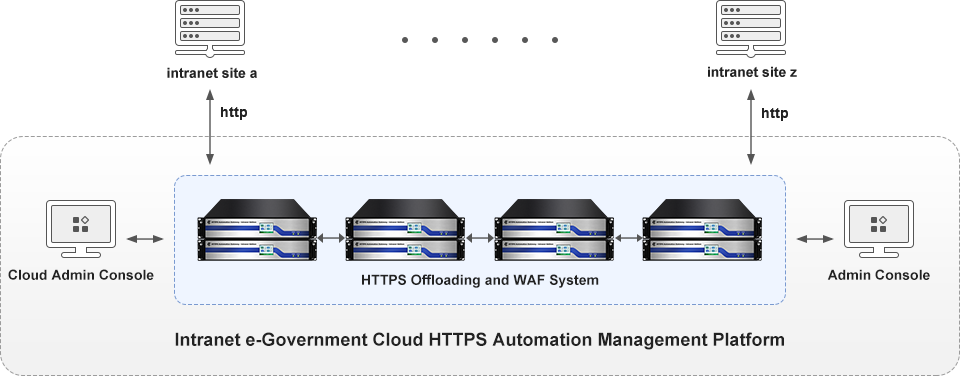
For government platforms or large enterprises with many Web systems across internal and external networks, multiple gateways can be deployed as a cluster to distribute HTTPS offloading and WAF processing and provide redundancy according to the design. Cluster size and failover scope should be planned based on performance requirements, network architecture, and business capacity.
8. Product Specifications and Performance
Model selection should consider target concurrency, TLS/TLCP handshake rates, throughput, interface types, certificate capacity, and business traffic growth in the next 5 years.
+ 4 × 10G, expandable
+ 4 × 10G, expandable
+ 4 × 10G, expandable
+ 4 × 10G, expandable
+ 4 × 10G, expandable
*Maximum throughput is based on four-port aggregation (MG-1-3 aggregates 4 Gigabit ports, while the rest are aggregated as 4 10-Gigabit ports, supporting more port aggregation). Actual performance depends on traffic characteristics, cryptographic algorithms, security policies, and deployment configuration. *
** All models can be expanded with 8 gigabit ports or 8 10-gigabit ports except MG-1-3.
◆ Certificate Configuration
The gateway supports dedicated ECC and SM2 certificate autoconfigurations for website domains. The specific certificate-related parameters are as follows:
- Issuing CA certificate validity: 10 years.
- Server SSL certificate validity: 90 days; renewal cycle: every 80 days.
- MG-1-3 supports up to 30 website domains.
- MG-9-3 and MG-11-3 supports up to 150 website domains.
- MG-10-3 supports up to 150 or 200 website domains.
- MG-8-3 and MG-13-3 support up to 100 or 255 website domains.
Each website can have its own certificate and private key. The gateway purchase includes five years of certificate automation service for the supported certificate configurations and website capacity. Hardware maintenance fees will be charged after five years.
◆ Customization
Hardware and deployment configurations can be customized according to specific throughput, website capacity, cryptographic processing, network interface, and infrastructure requirements.
Contact Zotrus for detailed technical specifications and configuration recommendations.
9. Typical Use Cases
Zotrus HTTPS Automation Gateway (Intranet Edition) is suitable for organizations that need to automatically implement HTTPS encryption and certificate management for multiple websites or business systems within the intranet. Typical scenarios include:
◆ Government and public-sector intranets
Provide automated intranet HTTPS, RSA/SM2 access, and centralized certificate management for government platforms, office systems, business portals, and cross-department Web applications.
◆ Financial institution intranets
Provide centralized HTTPS offloading, certificate lifecycle management, and security infrastructure integration for internal business Web systems and management platforms.
◆ Large enterprise intranets
Standardize HTTPS encryption and WAF protection for internal Web systems distributed across departments, campuses, data centers, and branch offices.
◆ Isolated and private networks
Use the built-in CA for local certificate issuance and management in environments that cannot connect to the Internet or should not depend on external cloud certificate services.
◆ SM2 and PQC migration
Provide gateway-side infrastructure for organizations deploying SM2 HTTPS, evaluating hybrid post-quantum key exchange, and progressively upgrading their cryptographic systems.
10. ZT Browser: An Optional Enhanced Security Client
Zotrus HTTPS Automation Gateway (Intranet Edition) works with existing browsers and client applications. Deploying the gateway does not require an organization to replace its current browsers. ZT Browser is a free optional companion client for organizations seeking pre-established trust in the Zotrus Intranet Root CA, broader cryptographic agility, and clearer visibility into website security attributes.
Based on Chromium, ZT Browser retains a familiar browsing experience while adding capabilities focused on cryptographic agility and digital trust. It is not a prerequisite for operating the gateway; it is a complementary client-side offering from Zotrus.
- Cryptographic agility: supports RSA, ECC, and SM2, as well as the X25519MLKEM768 and SM2MLKEM768 hybrid post-quantum key exchange algorithms.
- Visible website security: interface indicators display connection attributes such as HTTPS, hybrid PQC, and SM2, and can identify websites marked as protected by a WAF. When ZT Browser displays the WAF indicator that the website is protected by Zotrus Gateway WAF, users can identify that the Zotrus Gateway and its built-in WAF are deployed in front of the website.
- Website identity information: displays T1–T4 website identity indicators based on certificate-related OIDs, helping users understand the identity information provided by a certificate.
ZT Browser presents client-side cryptographic capabilities, website identity, and security status information. The gateway handles server-side certificate automation, HTTPS processing, and traffic protection. Together, they provide client/server-side capabilities that complement each other, while remaining independently deployable and usable.
11. Why Intranet HTTPS Automation Gateway?
Zotrus HTTPS Automation Gateway (Intranet Edition) integrates automated RSA OV + SM2 OV certificate issuance, PCIe HSM-protected SubCA private keys, pre-established browser trust, HTTPS encryption/decryption offloading, traffic forwarding, and Web protection in a dedicated gateway. Its self-sufficient intranet certificate model eliminates recurring purchases of individual intranet server certificates and supports predictable planning through a five-year deployment package.
From intranet HTTPS deployment and RSA/SM2 certificate automation adoption to hybrid post-quantum key exchange, organizations can plan cryptographic modernization around a unified gateway architecture. The gateway can also work with existing firewalls, IPS, WAF, Anti-DDoS systems, and load balancers as part of a network service chain.
Core value proposition: Intranet certificate self-sufficiency | PCIe HSM-protected SubCA keys | Dual RSA OV + SM2 OV certificates with the organization's name in the O field | Pre-established ZT Browser trust | Five-year deployment package | Model selection by website capacity and HTTPS processing capacity.
Automate Intranet Certificates. Automate Intranet HTTPS. Build Intranet Cryptographic Resilience.
Discover how Zotrus HTTPS Automation Gateway (Intranet Edition) can simplify intranet certificate management, modernize intranet cryptographic capabilities, and improve the efficiency of intranet website security infrastructure.
Contact Zotrus for Product Information and Deployment Consultation.