ZTmail Exploration Part 10:
Security + Cryptography: Building the Global Cryptographic Application Ecosystem
September 28, 2026
A secure digital world is not built by one security product or one cryptographic technology. It is built where identity, trust, cryptography, applications, infrastructure, and standards can work together across the workflows people already use. Email is one of the clearest examples, but the same principle increasingly applies to chat and digital documents. People communicate through email and chat, exchange and sign documents through those conversations, and expect the resulting identities, signatures, encryption, and validation to remain trustworthy across different applications and organizations.
This raises a broader question for the industry: if cryptographic technologies already exist for email, messaging, and documents, why do these capabilities still so often remain isolated inside separate products, platforms, and workflows? The challenge is no longer simply whether cryptography is available. The deeper challenge is how to make cryptographic applications interoperable, automated, and practical across the global digital ecosystem.
1. Cryptographic Applications Are an Ecosystem Problem
Security and cryptography are often presented as product capabilities: install a security gateway, configure certificates, enable encryption, deploy a signing service, or add a secure messaging platform. On a real-world scale, however, digital trust is not contained within a single application. Email involves mail platforms, security systems, certificate authorities, clients, identities, and trust relationships. Chat involves users, organizations, messaging applications, identity systems, and communication infrastructure. Documents move between email, chat, business systems, signing services, storage systems, and recipients who may use completely different applications.
S/MIME already provides a mature cryptographic model for email: certificates can bind identities to public keys, digital signatures can provide integrity and signer identity, and encryption can protect message contents. Digital signatures and encryption provide similar cryptographic foundations for documents, while secure messaging can apply cryptographic protection directly to conversations. The challenge is therefore less about whether the technology exists than about how to make these capabilities practical across the infrastructure and workflows that already carry global digital communication.
This makes cryptographic application automation an ecosystem problem rather than simply a product problem. The relevant question is not which existing system should be replaced, but how cryptographic capabilities can become dependable parts of the systems and workflows that already work, so that trust, security, communication, signing, encryption, and validation can operate as coordinated processes.
2. Everyone Is Already Good at Something
The existing digital ecosystem already contains mature specialists, each of which has spent years developing capabilities around a particular part of the overall workflow. Email platforms deliver and store messages; chat platforms provide real-time communication; security vendors inspect and protect content; certificate authorities validate identities and issue digital certificates within their trust frameworks; document platforms provide document signing and document management functions; email and chat clients provide user experiences; and cloud and AI platforms provide applications, infrastructure, and analysis.
None of these roles need to disappear for cryptographic applications to become easier to deploy. A security vendor does not need to become a certificate authority, a certificate authority does not need to become an email or chat platform, and a document service does not need to rebuild the entire identity infrastructure simply because cryptographic trust has become more important. An organization should not need to replace its existing communication and security infrastructure merely to introduce automated cryptographic capabilities.
The missing capability is the operational connection between these existing capabilities and everyday applications: the mechanism that can take certificates and trust, connect them with keys and cryptographic operations, and make the resulting functions available inside the workflows in which users already communicate, exchange documents, and conduct business.
3. Email Security Needs the Cryptographic Application Automation
The problems with email security can no longer be solved just by beefing up protective measures, it needs a dedicated cryptographic application layer to protect the emails security. Its job is not to become the mail server, the chat platform, the document-management system, the anti-malware engine, the DLP platform, or the AI model. Its purpose is to make cryptography usable inside those existing workflows and to connect cryptographic operations with the applications and infrastructure in which digital communication already operates.
That includes certificate enrollment and renewal, certificate selection, key protection, digital signing, signature validation, encryption, decryption, identity presentation, timestamping, and certificate lifecycle management. The deeper value lies in coordinating these functions so that they do not remain isolated administrative tasks. When cryptographic operations are automated and connected to application workflows, trust can become part of normal communication and document handling rather than a separate project that users and administrators must manage manually.
The digital certificate exists. The security stack exists. The messaging application exists. The document already exists. What is missing is the automation that makes these capabilities work together. A certificate by itself does not automatically place a usable cryptographic identity into an application, protect the associated keys, select the correct certificate for a signing operation, encrypt content for the intended recipients, or manage the lifecycle that follows.
4. Security + Cryptography: Two Capabilities, One Workflow
Security systems and cryptography address different parts of the trust problem. Security systems detect threats, inspect content, enforce policy, and respond to suspicious activity, while cryptography provides mechanisms for verifiable identity, integrity, confidentiality, and trusted signing. Treating them as competing layers creates an unnecessary architectural choice when they can instead be coordinated within the same workflow.
For email, a cryptographic gateway can operate alongside an existing email security gateway, allowing each system to perform the work for which it was designed. An inbound encrypted message may be decrypted under appropriate organizational controls, inspected by the existing security stack, and then delivered according to policy. Outbound mail can be inspected before it is digitally signed and, where required, encrypted for its recipients.
The same principle extends to documents. A document generated by a business system can be signed and encrypted according to identity and policy before being returned to the business workflow. In an email conversation, a PDF attachment can be digitally signed, timestamped, encrypted for one or more recipients, and sent without creating a separate document-signing workflow. Cryptographic operation becomes part of the existing workflow rather than another isolated destination.
Chat introduces the same architectural question in a different form. A conversation needs more than transport security if participants must know who they are communicating with and if sensitive messages require end-to-end cryptographic protection. A cryptographic application layer can connect trusted identity, key management, and message encryption to the chat experience while allowing the chat platform itself to remain focused on communication.
The objective is not to make security systems see less or to weaken cryptographic protection for the sake of inspection. It is to make security controls and cryptographic protection work together as coordinated parts of the same application infrastructure.
5. One Cryptographic Foundation, Three Application Forms
Once the problem is viewed across applications rather than within a single product category, a common foundation becomes visible. Email, Chat, and Document are different application forms, but they require many of the same underlying cryptographic capabilities: trusted identity, certificates, keys, signing, encryption, decryption, validation, and lifecycle automation.
ZTmail therefore treats Email, Chat, and Document not as three unrelated security products, but as three service forms built on a common cryptographic foundation and a unified Cryptographic Application Automation capability layer. ZTmail App brings cryptographic automation into email. ZTmail Chat extends trusted identity and encrypted communication into conversations. ZTmail Sign extends the same foundation into digital document signing, encryption, timestamping, and validation.
The advantage of this model is not simply reuse of technology. A common foundation allows identity and cryptographic capabilities to remain consistent as a user's communication moves from one application context to another. An email can introduce a trusted identity; a chat conversation can use that identity for trusted communication; a document exchanged through either workflow can be signed and encrypted using certificate-based cryptographic operations. The applications remain different, but the trust and cryptographic foundation can be coordinated.
6. The Email Conversation Can Become the Document Signing Environment
Document signing provides a particularly clear example of why application workflow matters. In many existing signing services, the document is moved into a dedicated platform: the user uploads it, creates a signing transaction, invites participants, completes the signing session, and later returns the signed document to the communication workflow. This model can be useful, but it creates a separate document workflow alongside the conversation in which the document originally appeared.
ZTmail Sign takes a different approach by making digital signing part of the email workflow. When a document already exists as an email attachment, the user can sign it directly from the email environment using a trusted identity certificate. The signed document can remain within the same conversation, be encrypted for its intended recipients, and later be validated from the resulting document.
ZTmail also separates the cryptographic signing operation from unnecessary document transfer. With cloud signing, the original document can remain on the user's device while ZTmail App generates a cryptographic hash and sends only the hash to the cloud signing service. The service signs the hash using its trusted signing certificate and returns the signature data, while ZTmail App completes the signing process locally. In this model, cloud signing does not require the original confidential document to leave the user's device.
This illustrates a broader principle: cryptographic application automation should follow the document and the communication workflow, rather than forcing users to leave that workflow simply because a cryptographic operation is required.
7. The Missing Industry Role: Cryptographic Application Automation Provider
Once the problem is viewed as an ecosystem problem, a distinct industry role becomes visible: the Cryptographic Application Automation Provider, or CAAP. This role exists because the industry already has certificate authorities, security vendors, email and chat platforms, document services, clients, and cryptographic technologies, but those capabilities do not automatically become one operational workflow simply because each component exists.
Certificate authorities provide certificates and trust. Security vendors provide detection, inspection, and policy enforcement. Email and chat providers provide communication infrastructure. Document platforms provide document workflows. Clients provide interfaces through which users communicate and work. The missing role is the provider that connects these capabilities and automates the cryptographic application lifecycle, turning certificate-based trust and cryptographic functions into capabilities that can participate directly in everyday applications.
A CAAP can connect certificate services, trust, keys, cryptographic operations, application infrastructure, and security workflows, allowing each participant to contribute what it already does best instead of requiring every participant to develop an overlapping set of capabilities. It is an integration and automation role with a clear architectural purpose, rather than another attempt to consolidate the entire security or communication stack.
The principle is simple: each related provider does what it does best. CAAP makes the pieces work together, so that the ecosystem can deliver a capability that would be difficult for any single participant to provide efficiently on its own.
8. Standards Make the Ecosystem Interoperable
An ecosystem needs more than individual capabilities. It needs common technical rules that allow independently developed components to work together, because without shared standards every connection becomes a proprietary integration that must be designed, implemented, and maintained separately.
RFC 8823, published by the IETF, extends ACME (RFC 8555) for end-user S/MIME certificates. It defines the use of an email identifier and an email-based challenge mechanism, and it explicitly considers ACME-aware mail user agents. In practical terms, it provides a standardized path for email applications to participate in automated S/MIME certificate workflows rather than treating certificate enrollment as an entirely separate manual process.
The significance of standards extends beyond email. The same principle applies wherever trusted identities, certificates, signatures, encryption, and validation need to cross application boundaries. Cloud signing, document validation, certificate-based identity, and secure messaging all benefit from standards that allow different providers to implement compatible components without creating a proprietary trust island.
This is why standards matter to a global cryptographic application ecosystem. With proprietary interfaces, the industry can produce capable products but still struggle to connect them efficiently. With open standards, different vendors can implement compatible components, build integrations around common technical foundations, and allow the ecosystem to expand beyond a single product or provider.
Standards define the path. Automation makes the path usable.
9. ZTmail: Turning the Model into a Working Ecosystem
ZTmail positions itself as a Cryptographic Application Automation Provider, and its architecture demonstrates what this model looks like when cryptographic capabilities are connected across multiple application forms. ZTmail App brings S/MIME automation into the email workflow. ZTmail Chat extends trusted identity and encrypted communication into chat. ZTmail Sign brings digital signing, encryption, timestamping, and validation into the document workflow. ZTmail Gateway extends cryptographic automation into organizational infrastructure and business systems.
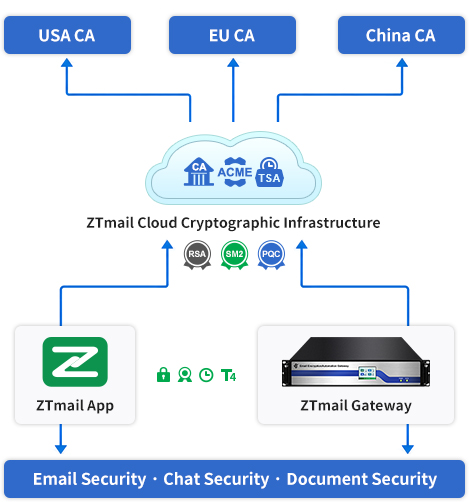
The important point is not that ZTmail must own every component. The point is that the complete workflow can be made operational: identities and certificates can be obtained through automated processes; keys and cryptographic operations can be managed within the appropriate infrastructure; email can be signed and encrypted; chat messages can be protected by trusted identity and encryption; documents can be signed, timestamped, encrypted, and validated; and these capabilities can participate in normal application workflows rather than remaining separate administrative procedures.
In this sense, ZTmail is not trying to become another email platform, another chat platform, another document-signing platform, another security stack, or another CA. It is implementing the role of a Cryptographic Application Automation Provider and demonstrating how existing capabilities can be connected through standards so that the industry can see not merely a collection of technologies, but a working model of how cryptographic applications can cooperate.
ZTmail built the model end to end because an ecosystem is easier to build when there is a working implementation that can demonstrate the complete path, provide a basis for integration, and show other participants where their own capabilities can connect. The purpose of building the first complete model is therefore not to close the ecosystem, but to make the ecosystem easier for others to join.
10. From One Working Practice to a Global Cryptographic Application Ecosystem
A successful ecosystem should not depend on one vendor. The objective is not to create another proprietary island for email, chat, or document security, but to establish an open model that more participants can implement, integrate with, and extend.
Other Cryptographic Application Automation Providers can offer their own implementations and services. Email clients can add automated S/MIME support. Chat platforms can integrate trusted identity and standards-based encryption. Document and business platforms can integrate digital signing, encryption, timestamping, and validation. Certificate authorities can provide certificate and trust services with automated certificate-management capabilities, while security vendors can integrate cryptographic workflows with their existing inspection and policy capabilities.
The ecosystem can therefore grow through specialization rather than consolidation. One company can provide identity and trust, another can provide security inspection, another can provide communication infrastructure, another can provide document services, and another can provide cryptographic application automation. The value comes from making these capabilities interoperable and operational.
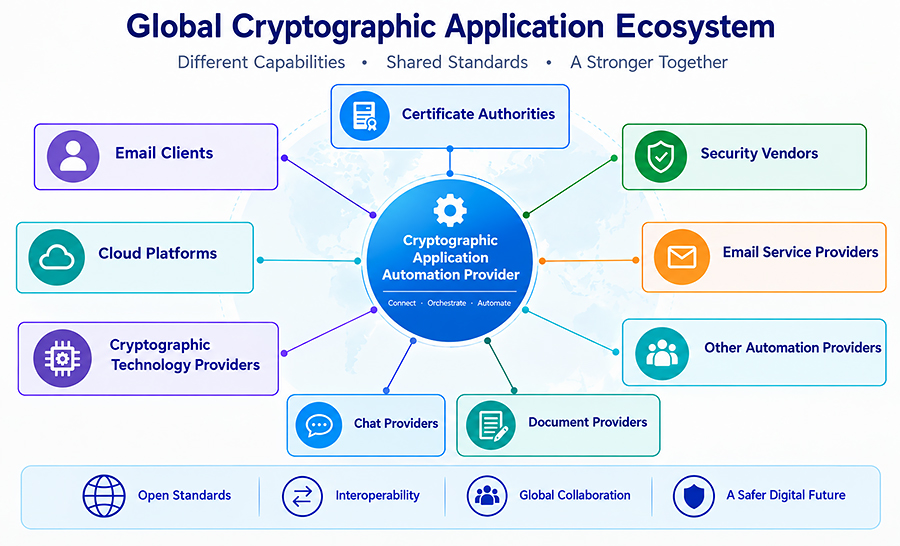
The goal is a global cryptographic application ecosystem in which Email, Chat, and Document are not isolated security islands. A trusted identity can be used where it is needed; cryptographic keys can remain under appropriate control; signatures can establish who signed; encryption can control who can read; trusted timestamps can establish when a signature exists; and validation can remain possible across the lifecycle of digital information.
11. Security + Cryptography for a Connected Trusted Digital World
The future of digital trust will not be created by choosing between security and cryptography, or by forcing every application to become a cryptographic platform. It will be created by connecting the capabilities that already exist and automating the cryptographic operations that are still too difficult to use in everyday workflows.
Email, Chat, and Document represent three important forms of digital communication and business activity. Each has its own user experience and infrastructure, but all can benefit from the same underlying principles of trusted identity, cryptographic protection, and automated certificate lifecycle management. The role of Cryptographic Application Automation is to make those principles practical without requiring every application provider, security vendor, certificate authority, or organization to rebuild the entire cryptographic stack.
ZTmail's objective is therefore larger than secure email alone. Email was the starting point because S/MIME already provides a mature standards-based foundation. Chat and Document extend the same cryptographic application model into other communication and business workflows. The next step is to make these capabilities easier for other participants to integrate, so that cryptographic applications can become part of a broader global digital infrastructure.
The goal is not to make ZTmail the ecosystem. The goal is to help build an ecosystem in which the industry can participate, contribute its own expertise, and expand the practical reach of cryptography across Email, Chat, and Document.
Security provides defense. Cryptography provides trust. Application automation connects them to the workflows where people communicate, sign, exchange, and act. Together, they can turn mature cryptographic technologies into practical, interoperable capabilities for the global digital world.
Click here to read PDF edition (digital signature and timestamp with global trust and global legal effect, all rights reserved, plagiarism is prohibited! Please indicate when reprinting: Reprinted from ZoTrus CEO Blog)