
1. Email Security Requires More Than S/MIME Certificates
S/MIME has long been a standards-based technology for email digital signatures and encryption. It enables recipients to verify the identity of a sender, helps protect the confidentiality of message content, and supports trusted digital communication between organizations and across the public Internet. The cryptographic foundations of S/MIME are mature, and the related standards and certificate infrastructure continue to evolve. Yet S/MIME has still not become a routine capability for most email users. The main obstacle is not a lack of cryptographic technology, but the operational complexity surrounding certificates, email applications, and the keys on which encrypted communication depends.
For S/MIME to become as easy to adopt as HTTPS, certificate operations must move from complicated manual procedures to reliable automation. Users should not have to understand certificate enrollment, identity validation, certificate installation, renewal, or cryptographic configuration before they can send and receive protected email. At the same time, automation must preserve the distinction between mailbox control validation and higher levels of identity validation, and must not compromise users' or organizations' control over their private keys.
Zotrus has therefore built a complete S/MIME ecosystem around three complementary layers: Certificate Management Automation, S/MIME Application Automation, and Key Management Automation. Each layer addresses a different barrier to S/MIME adoption. Together, they connect CA certificate services, email applications, enterprise infrastructure, and the long-term availability of encrypted communications.
To bring S/MIME into widespread use across the broader email environment, interoperability with standard email clients and the cost of certificate deployment must also be addressed. Through its Hybrid Trust dual-signature architecture, Zotrus combines global public CA trust with ZTmail Trust identity assurance, allowing compatible standard S/MIME clients to validate the globally trusted signature while ZTmail App displays higher-assurance identity information, without requiring every user to obtain a higher-cost globally trusted identity certificate.
2. Why Email Certificates Need Certificate Management Automation
The widespread adoption of HTTPS demonstrates that certificate-based security can become part of everyday Internet operations when certificate management is automated. Website owners no longer need to handle every certificate operation manually. Automated protocols and services can support domain validation, certificate issuance, deployment, and renewal, making TLS certificates part of a website's normal operational lifecycle.
Email certificates need a comparable approach. In a traditional S/MIME deployment, users or administrators may have to choose a certificate authority, submit an application, complete identity validation, obtain the issued certificate, install it in the appropriate certificate store, configure the email client, and repeat some of these steps when a certificate expires or needs to be replaced. The procedures can vary across operating systems, devices, email clients, and organizational environments. Even when a certificate is available, the work required to put it into practical use can remain a barrier to S/MIME adoption.
Certificate Management Automation addresses this operational burden by connecting the certificate authority with the application that uses the certificate. Depending on the applicable certificate policy and validation level, the automated workflow can handle certificate enrollment, validation interactions, certificate retrieval, installation or configuration, and lifecycle operations such as renewal and replacement. This reduces repetitive work for users and administrators and helps keep certificates available for their intended purpose throughout their lifecycle.
For S/MIME, one important protocol foundation is RFC 8823. It defines ACME extensions for end-user S/MIME certificates and provides a standardized mechanism through which an ACME-capable mail user agent can participate in automated S/MIME certificate management. This is an important step in moving email certificate operations away from disconnected manual procedures and into integrated application workflows.
Zotrus has extended its existing TLS/SSL certificate automation capabilities into the S/MIME domain by building ACME services that support RFC 8823 and integrating them with its CA systems and ZTmail applications. The resulting ecosystem supports S/MIME certificates using RSA and SM2 algorithms, subject to the applicable certificate profiles, trust framework, and identity-validation requirements.
3. Why Certificate Management Automation Alone Is Not Enough
Automating certificate issuance is necessary, but it is not sufficient to make S/MIME easy to use. A certificate that has been issued but is not correctly installed, selected, and used by an email application does not protect actual email communications. If users still need to understand certificate stores, import certificate files, configure signing and encryption options, exchange certificates, and troubleshoot compatibility issues, much of the original complexity remains.
The second layer is S/MIME Application Automation. It directly connects certificate management with the email application or enterprise mail environment in which cryptographic operations take place. Rather than treating certificate enrollment and secure email use as separate tasks, the application integrates them into a coherent workflow and makes the relevant security capabilities part of the user's normal email experience.
At the application layer, S/MIME automation covers the core operations required for protected email communication, including digital signing, signature verification, encryption, and decryption. It also includes application-side certificate handling and the presentation of trusted identity information, helping users understand the security status of a message without having to interpret complex certificate data themselves.
This integration is particularly important for individuals and small and medium-sized businesses, which generally do not have dedicated PKI administrators. ZTmail App integrates certificate lifecycle automation with core S/MIME cryptographic capabilities in an email application designed to reduce the specialist knowledge users need. Its purpose is not to weaken cryptographic protection or blur distinctions between identity-validation levels, but to make the complete core S/MIME workflow practical for everyday email communication.
Large organizations face a different practical constraint. Because of existing business processes, compliance requirements, and long-term technology investments, enterprises often need to retain their current email platforms, mail servers, and desktop or mobile email clients. Requiring every employee to switch email clients is often unrealistic. For these environments, ZTmail S/MIME Automation Gateway provides an enterprise deployment path that integrates S/MIME automation with existing email infrastructure, without making a change of email client a prerequisite.
4. Why S/MIME Key Management Automation Is Essential
The third layer is S/MIME key management that often overlooked, yet it is fundamental to the long-term usability of encrypted email. Encryption protects message content, while keys determine whether users can continue to access that content. When an email is encrypted for a recipient, the ability to decrypt it in the future depends on continued access to the corresponding private key. Renewing a certificate or generating a new key pair does not automatically enable the new key to decrypt previously received encrypted messages.
This creates a lifecycle-management challenge that goes beyond certificate renewal. Users may replace computers or phones, reinstall applications, move to new devices, or lose access to the original environment in which a private key was created. If the private key is lost and no usable backup exists, historical messages encrypted with the corresponding public key may no longer be decryptable. For organizations, the same issue can affect employee departures, role changes, device replacement, records retention, and business continuity.
Key Management Automation is intended to manage keys securely and preserve their availability throughout their useful lifecycle. Depending on the deployment model, this can include protected key backup, recovery, synchronization, and migration between authorized devices or environments. The objective is to make key continuity easier to manage without confusing automation with transferring ownership or unrestricted control of private keys to a cloud service.
For individual users and smaller organizations, the ZTmail key-management approach uses an encrypted key-backup archive that can be stored in a dedicated folder in the user's own mailbox. The backup archive can be updated as the user's key material changes and retrieved when the user moves to another device. A Recovery Key held by the user protects the backup and is used to recover it. This approach is designed to use the user's own mailbox for backup storage while keeping the recovery secret under the user's control.
The Recovery Key must be kept securely. If it is lost, the encrypted backup may no longer be recoverable; and if the backup archive itself is lost, possession of the Recovery Key alone cannot recreate it. Users therefore need to protect both the backup archive and the Recovery Key. These remain important security responsibilities even when the backup and recovery workflow is automated.
Enterprise environments may require a different key-governance model. An organization may use an Enterprise Key Management System (EKMS) or S/MIME Automation Gateway to implement employee key-backup and recovery policies, with key custody and access governed by the organization's security and compliance requirements. The appropriate model depends on the organization's responsibilities, system architecture, and management policies. Automation should support those controls rather than assume that every organization should use the same key-custody arrangement.
5. Why Zotrus Had to Build a Complete Ecosystem
The challenges involved in S/MIME adoption cannot be solved by a single, isolated product. A practical end-to-end service requires the CA, the ACME service, the email application or enterprise gateway, and key-management capabilities to work together. These components must be coordinated in terms of protocols, certificate profiles, identity-validation workflows, data formats, security boundaries, and operational responsibilities. A gap in any one area can leave users with a technically valid certificate but no convenient way to use or preserve it.
First, the CA systems must be able to issue S/MIME certificates in accordance with the applicable technical standards and certificate policies, including certificates based on RSA and SM2 algorithms where supported by the relevant certificate profiles. S/MIME certificate issuance cannot simply be treated as equivalent to TLS certificate issuance, because S/MIME certificates have their own key-usage, identity, and policy requirements. There aren't any systems on the market right now that fully meet the requirements, so the Zotrus CA system must support issuing S/MIME certificates with dual algorithms.
Second, the ACME service must support RFC 8823. Zotrus' existing experience with SSL/TLS certificate automation provided a foundation, but an ACME service designed only for website certificates cannot automatically be assumed to support S/MIME workflows. The S/MIME-specific protocol extensions and certificate-management requirements must be implemented and integrated.
Third, the automated workflow requires a compatible email client that can participate in the process and apply the issued certificates to actual email operations. No off-the-shelf email client available in the market provided the complete workflow Zotrus intended to deliver. Zotrus therefore developed ZTmail App to integrate certificate management with S/MIME digital signing, signature verification, encryption, and decryption.
Fourth, the enterprise market needs an alternative that does not require organizations to replace their existing email clients. Many organizations want centralized deployment and consistent security policies while retaining their current mail systems. This is why Zotrus also developed the enterprise S/MIME Automation Gateway as a complementary deployment path for larger organizations.
Finally, the ecosystem must address key continuity. Without backup and recovery, users may lose access to historical encrypted email when devices or certificates change. Individuals and enterprises have different requirements for key custody, so the ecosystem needs to support both user-controlled recovery and organization-governed key management.
Zotrus' decision to develop these components and integrate them into a complete ecosystem is a response to practical engineering challenges and real barriers to adoption. The objective is not simply to combine a collection of unrelated tools, but to connect the entire path from certificate issuance and everyday encrypted email communication to the long-term availability of the keys that make that communication accessible.
6. The Zotrus S/MIME Certificate & S/MIME Automation Ecosystem
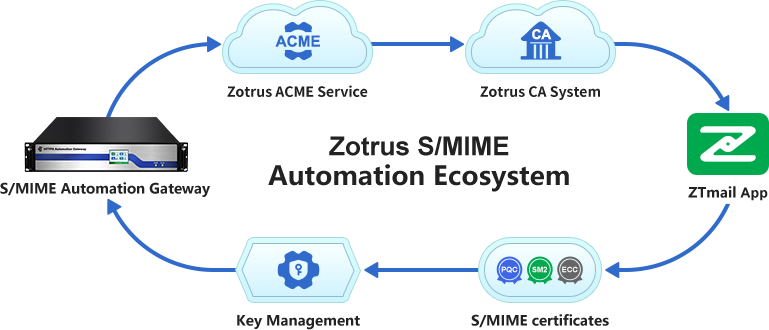
The Zotrus ecosystem brings together the infrastructure and applications needed to automate S/MIME for individuals, small and medium-sized businesses, and large organizations. Each core component has a distinct responsibility, while working with the others through the protocols and business workflows required for end-to-end operation. The whole ecosystem is mainly made up of six parts, as shown in the picture below.
(1) Zotrus CA System and S/MIME Certificate
The Zotrus CA systems issue S/MIME email certificates in accordance with applicable certificate profiles and identity-validation policies. The ecosystem supports different identity-validation levels, including MV, IV, OV, and SV, and supports RSA and SM2 algorithm options where permitted by the relevant certificate profiles and trust framework. An identity-validation level represents the assurance applied to the certificate subject; it should not be confused with the cryptographic capabilities available in the email application.
(2) Zotrus ACME Service for S/MIME
The Zotrus ACME service implements the S/MIME-specific automation workflow defined by RFC 8823. It connects supported mail user agents with certificate services, allowing certificate enrollment and lifecycle management to be carried out through a standardized protocol rather than a series of disconnected manual procedures.
(3) ZTmail App
ZTmail App is the application path for individuals and small and medium-sized businesses. It integrates email communication, automated S/MIME email certificate management, and core cryptographic operations. The Free Edition provides T1/MV mailbox-validated certificates and the complete core S/MIME cryptographic capabilities, including digital signing, signature verification, email encryption, and decryption. The complete ZTmail offering extends certificate automation to the IV, OV, and SV identity-validation levels through the corresponding editions and services.
The distinction between cryptographic application capabilities and identity assurance is deliberate. The Free Edition is not a feature-limited demonstration version; it provides the complete core S/MIME workflow while using the T1/MV identity-validation level and ZTmail Trust. Higher validation levels address stronger identity-assurance requirements and broader trust needs, rather than simply unlocking basic email encryption functionality.
(4) ZTmail S/MIME Automation Gateway
ZTmail S/MIME Automation Gateway is the enterprise deployment path for organizations that need S/MIME automation across their existing email infrastructure. It is designed to work with established email systems and clients, enabling organizations to advance automated certificate management and S/MIME cryptographic operations without requiring every employee to replace their email application. It complements ZTmail App by serving a different deployment environment while pursuing the same objective of making S/MIME easier to use and manage.
(5) Key Management Automation
Key-management capabilities address private-key backup, recovery, and continued access, with the implementation model determined by the deployment environment. Individual users can retain control of their Recovery Key and use their own mailbox to store an encrypted backup archive, while enterprise environments can implement organization-level key governance through an EKMS. The core objective is to keep the keys required for encrypted communication available while respecting the appropriate control model for users or organizations.
7. Three Layers of Automation Working Together
The three layers are not separate features that happen to exist within the same product family. They form an interconnected operating model. Certificate Management Automation obtains and maintains the certificates required for S/MIME. S/MIME Application Automation puts those certificates to work in the email environment, performing digital signing, signature verification, encryption, and decryption as part of the user's everyday communication workflow. Key Management Automation helps preserve access to the private keys required to decrypt messages over time and across authorized devices or organizational processes.
When these three layers work together, users no longer need to treat certificate enrollment as a separate technical project, manually configure every cryptographic function, or rely on ad hoc methods to preserve private keys. Administrators can also adopt a more consistent operational model and select the deployment approach that best fits the organization's size and existing infrastructure.
The architecture supports two complementary deployment models. ZTmail App brings the automated workflow directly to individuals and SMBs, emphasizing ease of use and user-controlled key recovery. ZTmail S/MIME Automation Gateway serves large enterprises that need integration with existing email infrastructure and organization-level key governance. Both deployment paths are built on the same broader principles of CA services, S/MIME-capable ACME automation, and key management.
8. Hybrid Trust: Dual Signatures for Global Interoperability, Trusted Identity, and Practical Deployment Costs
Certificate Management Automation, S/MIME Application Automation, and Key Management Automation address how S/MIME certificates can be obtained, used, and managed over time. However, widespread adoption requires two additional practical challenges to be addressed. First, signed messages sent by ZTmail users must interoperate with other S/MIME clients across the broader email ecosystem; recipients should not be required to switch to ZTmail App. Second, if every user and every mailbox must obtain a higher-assurance S/MIME certificate issued by a global public CA, certificate costs can become a substantial obstacle for individuals and large-scale enterprise deployments.
These two challenges are closely related. Using only IV, OV, or SV identity certificates issued under ZTmail Trust can provide richer trusted-identity information within the ZTmail ecosystem, but standard email clients that do not have the corresponding trust chain configured may not recognize those signatures as globally trusted. Conversely, requiring every user to obtain a globally trusted IV, OV, or SV certificate from a public CA may help external clients validate the signature, but it can significantly increase certificate procurement costs, especially for organizations deploying S/MIME across large numbers of employees and mailboxes.
Zotrus's Hybrid Trust model addresses interoperability and cost through a dual digital-signature mechanism. It does not simply place two certificates together, nor does it turn a ZTmail Trust certificate into a globally trusted public certificate. Instead, the two trust systems perform complementary roles. A globally trusted MV (Mailbox Validated) S/MIME certificate issued by a public CA establishes a global trust path that standard S/MIME clients can validate. A separate IV, OV, or SV identity certificate issued under Zotrus's ZTmail Trust provides higher-assurance identity information and trusted-identity presentation within the ZTmail ecosystem.
When signing an email, ZTmail App uses the globally trusted MV certificate to create a standard S/MIME digital signature and adds a second signature through a compatible CMS (Cryptographic Message Syntax) signature structure. The second signature is generated using an IV, OV, or SV identity certificate under ZTmail Trust. The resulting email contains two independently verifiable signatures, each of which is evaluated according to its corresponding certificate chain, signature structure, and trust policy.
For recipients using Microsoft Outlook or other compatible standard S/MIME clients, the client can use its existing public CA trust configuration to validate the signature associated with the globally trusted MV certificate and, when validation succeeds, display the corresponding valid S/MIME signature status. Recipients do not need to install ZTmail App or rely on the ZTmail Trust chain to validate this global trust path. The actual validation result still depends on the client's support for the relevant S/MIME/CMS signature structure, as well as its certificate-chain processing and local trust configuration.
For recipients using ZTmail App, the application can validate the global-trust signature and also validate the second identity signature based on ZTmail Trust. It can then read the relevant identity-certificate information and display the corresponding T2 (IV), T3 (OV), or T4 (SV) trusted-identity designation and identity details. In this way, ZTmail App preserves global S/MIME interoperability while providing richer personal or organizational identity information than mailbox-control validation alone.
The value of Hybrid Trust is not simply that it reduces certificate procurement costs. It makes S/MIME deployment more economically practical while preserving the identity assurance required for secure email communication. The widespread adoption of DV certificates has demonstrated that affordable certificates can help make HTTPS security available at scale. Email, however, has different trust requirements from website HTTPS. Email security must protect message confidentiality, but recipients also need to assess who the sender is. S/MIME adoption should therefore not stop at mailbox-control validation (MV); depending on the communication scenario, it should also provide higher levels of personal or organizational identity validation through IV, OV, and SV.
By combining globally trusted MV certificates issued by public CAs with IV, OV, or SV identity certificates issued under ZTmail Trust, Hybrid Trust establishes a practical balance among global interoperability, identity assurance, and deployment cost. The dual-signature approach allows compatible standard S/MIME clients to validate the globally trusted signature, while ZTmail App can additionally validate the ZTmail Trust signature and display the sender's higher-assurance personal or organizational identity information. This makes it possible to expand trusted S/MIME communication without requiring every user to obtain a higher-cost, globally trusted identity certificate, creating a more sustainable cost structure for large-scale deployment.
Hybrid Trust is therefore neither a compromise that sacrifices global interoperability to reduce costs nor a model that requires every user to bear the cost of a globally trusted higher-assurance certificate. It separates global trust from ecosystem-level identity trust through dual signatures, then brings the two together in the identity experience provided by ZTmail App. This is a key architectural innovation through which Zotrus addresses the practical requirements of widespread S/MIME adoption and connects the ZTmail ecosystem with the broader world of email clients.
9. From Standards to Practical S/MIME Adoption
Standards provide the technical foundation for secure and interoperable communication, but standards alone do not remove the practical barriers that prevent users from adopting a technology. RFC 8823 defines the ACME extensions needed for automated management of end-user S/MIME certificates, while the CA/Browser Forum's S/MIME Baseline Requirements establish requirements for the issuance and management of S/MIME certificates. These specifications help define how certificate services should operate, but they do not, by themselves, provide users with an integrated email client, an enterprise deployment model, or a sustainable approach to key backup and recovery.
Zotrus focuses on bridging the gap between standards and practical adoption. By integrating CA capabilities, RFC 8823-based ACME services, email applications, enterprise gateway deployment, and key-management workflows, Zotrus turns standards-based capabilities into a product ecosystem that users and organizations can actually deploy, use, and operate.
The same principle applies to algorithm selection and trust. Supporting RSA and SM2 gives deployments options suited to different technical and policy environments, while the MV, IV, OV, and SV validation levels distinguish the levels of identity assurance associated with certificates. These dimensions must remain clearly differentiated: the choice of cryptographic algorithm does not itself determine the identity-validation level, and the availability of complete core S/MIME cryptographic functions does not mean that all certificates provide the same scope of trust.
Zotrus's long-term goal is to make secure email communication genuinely easy to use, without requiring every user to become a PKI specialist or every organization to build a customized S/MIME operating environment. Achieving this goal requires automation across the complete lifecycle, from certificate management and application use to key continuity.
Through the coordinated operation of Certificate Management Automation, S/MIME Application Automation, and Key Management Automation, Zotrus aims to make trusted and encrypted email communication easier to adopt, simpler to use, and sustainable over time for individuals, small and medium-sized businesses, and large organizations.