ZTmail Exploration Part 4:
Key Management Is Key to S/MIME Adoption
September 18, 2026
Email encryption is often evaluated at the moment a message is sent: Was the message encrypted? Was the sender’s digital signature valid? Could an unauthorized party read the content while it was in transit or stored on a server? Those questions are essential, but they describe only one part of the problem. For users who depend on S/MIME, the more difficult question may emerge months or years later, when a computer is replaced, an operating system is reinstalled, an email client is migrated, or a certificate is renewed and the original private key is no longer available. At that point, an encrypted message can remain perfectly protected while becoming permanently inaccessible to the person who was supposed to read it.
This is one of the less visible barriers to broader S/MIME adoption. Encryption is designed to prevent unauthorized access, but the same mechanism creates a long-term dependency on the correct private key. If that key is lost, damaged, excluded from a backup, or left behind in an old client installation, the protection that once represented security can become a source of operational regret. A practical email-encryption strategy therefore cannot stop at certificate issuance or message encryption. It must also address how keys are generated, protected, backed up, recovered, migrated, and retained for as long as the encrypted correspondence may matter.
1. Encryption Protects Messages, but Keys Preserve Access
The distinction between a certificate and a private key is central to understanding the problem. In an S/MIME encryption workflow, a sender generally uses the recipient’s public key to encrypt a message. The corresponding private key, held by the recipient, is required to decrypt it. The certificate may expire, be renewed, or be replaced, but a new certificate cannot reuse the original private key. If an old message was encrypted to an earlier public key and the matching private key has disappeared, the message cannot be recovered simply by obtaining a newer certificate for the same mailbox or person.
This is why certificate lifecycle management, and key management should not be treated as interchangeable terms. Certificate lifecycle management covers activities such as requesting, validating, issuing, deploying, renewing, replacing, and revoking certificates. Key management covers a different set of responsibilities: generating or importing keys, protecting them during use, backing them up, recovering them, transferring them between environments, and ensuring that the correct historical key remains available when an older message must be opened. ACME only solves the certificate automatic management while still leaving users exposed to the most consequential failure in encrypted email: the loss of the private key needed to read the past.
The practical implications are easy to underestimate. A user may export a certificate without including its private key, assume that a new certificate will decrypt older messages, or believe that moving an email account to a new computer also moves the cryptographic material associated with it. In other cases, the key remains in a platform-specific certificate store that is not included in a normal file backup. Multiple mailboxes, multiple certificates, expired certificates, and different email clients can make the situation even harder to understand. The resulting failure is not necessarily a cryptographic weakness. It is often a failure of continuity design.
2. Why Traditional S/MIME Workflows Fail Over Time
S/MIME was designed around sound public-key cryptography, but many traditional user workflows place too much responsibility on people who are not expected to act as key administrators. The user is asked to request a certificate, install it in an email client, export it correctly, preserve the private key, repeat the process after a device change, and understand which certificate corresponds to which historical message. Each individual step may be manageable in isolation. The difficulty comes from the fact that the steps are distributed across applications, operating systems, certificate stores, backup tools, and organizational policies.
The problem becomes particularly serious during migration. An employee may move from one Windows installation to another, replace a laptop, change email clients, or switch between a desktop and a mobile device. The mailbox and its messages may migrate successfully, yet the private key may not. Even when a certificate is imported, the import may contain only the public certificate and not the private key. The user can still see the certificate in a management interface, which creates the impression that everything is in place, while the historical encrypted messages remain inaccessible.
A robust S/MIME design must therefore treat migration and recovery as normal operating conditions rather than exceptional events. The relevant question is not simply whether a certificate can be issued automatically today. It is whether the user or organization can still decrypt the messages that matter after a device failure, a software change, a personnel change, or a long period of time.
3. Automating Backup Without Taking Ownership of the Key
ZTmail approaches this problem by separating automation from ownership. ZTmail App can automate the creation, packaging, storage, synchronization, and restoration of backup data without requiring the user to surrender control of the secret needed to decrypt that backup. Instead of sending a readable copy of the user’s key material to ZTmail cloud repository, ZTmail App packages the relevant backup data into an encrypted archive and stores it in a dedicated folder in the user’s own mailbox.
The distinction is important because a user’s mailbox may already be a cloud service. Using that mailbox as the storage location does not mean that ZTmail must maintain a second readable copy of the backup in its own cloud infrastructure. The mailbox provider supplies the ordinary benefits of cloud storage—availability, synchronization, redundancy, and access from a new device—but the plain text self remains an encrypted file rather than a normal plain text email. The provider can store and deliver the file, but it cannot simply open the archive and read the protected key material without the user-controlled recovery key.
This model does not attempt to eliminate the cloud. It uses the cloud as a storage medium while keeping decryption authority outside the control of the mailbox provider. The design therefore combines two objectives that are often presented as competing choices: the reliability and convenience of cloud-based storage, and the user’s ability to control access to the protected backup. ZTmail App performs the operational work automatically, but automation does not transfer ownership of the recovery key to anyone else; it stays under the user's control, kept in user’s hand.
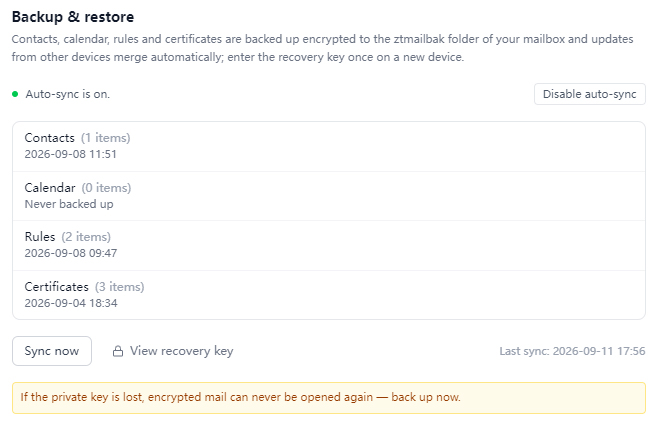
Figure 1. ZTmail App’s backup & restore interface, showing backup status, synchronization, recovery-key access, and the warning about lost private keys.
4. Recovery Is a User Responsibility, Even When Backup Is Automatic
ZTmail App’s recovery process is deliberately designed around a user-controlled Recovery Key, it can also be understood as a 'turnkey project'. The automatic encryption backup and automatic recovery mechanisms are all set up, and what’s handed over to the user to keep is the recovery key. Users may preserve that key digitally according to their own security practices, but ZTmail recommends maintaining a handwritten copy in a secure paper notebook or another protected offline location. The recommendation is practical rather than symbolic: a recovery mechanism should not depend entirely on the same account, device, or cloud channel that holds the encrypted backup. If the device has been replaced, the user still needs an independent way to supply the secret required to unlock the archive.
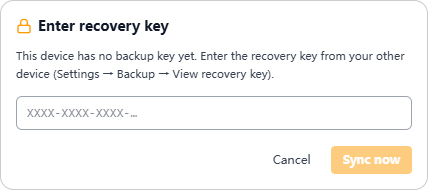
Figure 2. ZTmail App 'Enter Recovery Key' interface, users can enter the recovery key they have kept restoring certificate keys and contacts backed up in their own mailbox.
If the mailbox is no longer available and the encrypted backup has not been preserved elsewhere, the backup cannot be recovered. The Recovery Key alone does not recreate a lost backup; the encrypted backup archive must still be available in the user’s mailbox. The Recovery Key provides the ability to decrypt the backup; it does not replace the backup itself.
This design also clarifies the limits of automation. ZTmail can automatically create and update the encrypted backup, place it in the dedicated mailbox folder, and retrieve it when the user moves to a new device. It cannot responsibly remove the user’s responsibility to protect the Recovery Key. If the recovery key is lost, the encrypted archive may remain available but unusable. The system can automate the backup operation; it cannot make a user-controlled secret recoverable after that secret has itself been destroyed. This is the division between user self-management and automation, rather than using a fully managed mode that users can't fully control the key.
The underlying principle is therefore straightforward: automation removes the work involved in key backup, not the user’s authority over recovery. Users can see that synchronization is active, inspect the backup status, and view the recovery-key, while the protected archive remains separate from an ordinary readable message. This gives the user a visible and understandable recovery model without requiring manual export and storage of private-key files every time a certificate is issued or a device changes.
5. Various key management modes are suitable for different application scenarios
Individual users and enterprises may have different expectations about who should control recovery. For an individual or a small business using ZTmail App, mailbox-based encrypted backup can be appropriate when each user is expected to retain control of the Recovery Key. The user’s mailbox becomes the storage location, while the user remains responsible for preserving the secret required to restore the backup.
An organization may instead require centralized control over employee encryption keys, particularly when it must support employee departures, device replacement, business continuity, audit requirements, or formal recovery procedures. In that case, asking the organization to collect and administer a separate Recovery Key from every employee may create unnecessary complexity and an additional concentration of sensitive material. The enterprise would need to establish procedures for collecting, validating, protecting, updating, and restricting access to those recovery secrets, this is not a good solution.
For this scenario, ZTmail offers an optional Enterprise Key Management System (EKMS), for organizations do not deploy ZTmail S/MIME Automation Gateway, but want a centralized key-management model while continuing to use ZTmail App. In this model, employee encryption keys are supplied and managed through the EKMS system, and the corresponding backups are retained by the organization rather than stored in individual employee mailboxes. The enterprise assumes responsibility for key custody, recovery, access control, and continuity, while employees do not need to maintain a separate mailbox-based backup for enterprise-managed keys.
These are not contradictory approaches. They place responsibility in different hands. Mailbox-based backup emphasizes individual control and convenience. EKMS emphasizes centralized enterprise custody and recovery. The important principle of design is that the location of the backup, the holder of the recovery secret, and the party responsible for restoring access should be aligned with the organization’s actual security and operational requirements.
6. Key Management Is the Foundation of Sustainable Encryption
The broader lesson for S/MIME adoption is that encryption should be evaluated across time, not only at the point of transmission. A message may be encrypted correctly, a signature may be validated correctly, and a certificate may be issued through an efficient automated process, but if user can't decrypt the encrypted emails when users need them, then the whole encryption setup is a failure. Long-term accessibility is part of the goal of email encryption, not some management detail that can be postponed.
ZTmail’s approach treats key management as a continuing part of the S/MIME automation experience. Existing certificates and private keys can be imported so that previously encrypted correspondence remains accessible. Users can manage multiple available certificates and choose the appropriate default for signing or encryption. Backup and synchronization can occur automatically, while the recovery key remains under user control. For organizations that need centralized custody, the Gateway or the EKMS model provides a different operational path rather than forcing every user into the same key management arrangement.
The result is a more complete interpretation of email encryption: cryptography protects the message, certificate automation reduces deployment friction, and key management automation preserves access to the message over time. Cloud infrastructure can provide reliable storage without becoming the holder of the user’s decryption authority. Automation can make the process practical without taking ownership away from the person or organization responsible for the keys. In that sense, the real measure of an encryption system is not only whether it can protect today’s message, but whether it can still open yesterday’s encrypted message when tomorrow’s circumstances are different.
Click here to read PDF edition (digital signature and timestamp with global trust and global legal effect, all rights reserved, plagiarism is prohibited! Please indicate when reprinting: Reprinted from ZoTrus CEO Blog)