ZTmail Exploration Part 3:
Identity Made Visible: How Validated Identity Is Redefining Trust in Email
September 17, 2026
Generative AI is making email communication more intelligent and efficient, helping users draft messages, summarize information, and automate workflows. Yet greater intelligence does not automatically create greater trust. As AI-generated communication becomes increasingly realistic and easier to produce at scale, email security faces a fundamental challenge: how can recipients and security systems determine with confidence who is actually behind a message?
Business Email Compromise (BEC) exposes this challenge clearly. Unlike traditional attacks that depend on malware or technical vulnerabilities, many BEC campaigns succeed by exploiting trust. Attackers impersonate executives, suppliers, customers, and business partners, relying on recipients to accept a false identity as legitimate. AI does not change the nature of this threat, but it significantly improves an attacker’s ability to create convincing communication that resembles normal business correspondence.
For years, email security has focused on detecting suspicious content through message inspection, threat intelligence, reputation analysis, and behavioral monitoring. These capabilities remain essential, but they operate within a fundamental limitation: they attempt to determine whether a message appears suspicious after it has already been created. As attackers become increasingly capable of producing realistic messages by AI, the industry needs a stronger foundation that can establish whether the sender identity itself can be trusted.
1. Breaking Through the Detection Ceiling with Cryptographic Identity
The core weakness of content-based detection is that many BEC attacks do not contain obvious technical indicators. A fraudulent message may use appropriate language, match a business context, and imitate the communication style of a trusted individual. The central question is therefore not only what the message contains, but whether the identity behind the message is authentic.
Digital signatures provide this missing layer of trust by linking communication with a cryptographically protected identity. Through S/MIME, email systems can associate sender’s identities with certificates and allow recipients to validated that a message was digitally signed by the corresponding identity certificate and that the content has not been modified.
The industry has never lacked a cryptographic foundation for trusted email. The challenge has been transforming that foundation into a practical capability that can operate at everyday communication scale. Certificate enrollment, deployment, renewal, and key management have historically introduced operational complexity that limited adoption.
Automation changes this model by integrating certificate lifecycle management and signing operations into existing email workflows. When these processes become transparent to users and manageable for organizations, cryptographic identity can move from a specialized security capability into a practical communication standard.
2. Making Validated Identity Visible in Email
Although S/MIME certificates contain valuable identity information, this information has traditionally remained hidden inside technical certificate fields. The trust established through certificate authorities and identity validation processes exists, but ordinary users rarely see or understand that information when deciding whether to trust an email.
The success of HTTPS provides an important lesson. Secure browsing was not adopted widely only because encryption technology existed; it became universal because browsers made trust visible at the point where users made decisions. The browser interface translated complex certificate validation into a simple security experience.
Email requires a similar transformation. ZTmail addresses this challenge by converting certificate-based identity assurance into visible trust information within the email experience. Instead of requiring recipients to inspect certificates manually, ZTmail App presents validated identity information directly within the email interface, allowing users to understand not only whether a signature is valid, but also the assurance level behind the sender identity.
According to the CA/Browser Forum defined standards for S/MIME identity trust levels, each digitally signed email includes either mailbox validation (MV), individual validation (IV), organization validation (OV), or sponsor validation (SV). These trusted identities can serve as meaningful trust signals, rather than just hidden technical metadata.
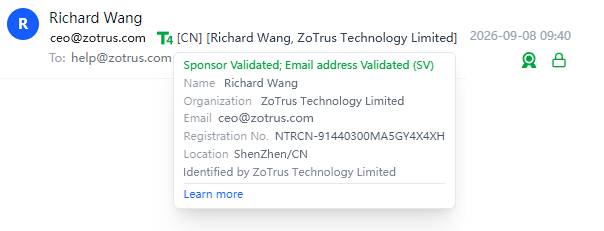
Figure 1. ZTmail App displaying validated identity information in the email header, allowing recipients to view the sender’s identity trust level and associated organization information.
3. From Human-Visible Trust to Machine-Visible Security
Validated identity creates value beyond user awareness because the same trust information can also become an actionable signal for enterprise email security systems. ZTmail extends identity visibility from the application layer into the email security infrastructure through its cryptographic gateway architecture.
While ZTmail App makes trusted identity visible to people, ZTmail Gateway makes trusted identity visible to email security systems. A gateway can evaluate the validated identity associated with incoming messages and incorporate that information into automated security policies. Organizations can use identity assurance as an additional factor when deciding whether communication should be released, monitored, or subjected to further controls.
This changes the role of trusted digital identity in email security. Identity is no longer only information displayed to users; it becomes a security signal that security systems can evaluate and act upon. Human-visible trust helps users make better decisions, while machine-visible trust enables organizations to automate security enforcement based on verified sender information.
4. Creating an Identity-Based Email Security Lifecycle
A complete identity-based email security model requires validated identity throughout the email communication lifecycle. When sending messages, email clients like ZTmail App and enterprise gateway systems like ZTmail Gateway use appropriate identity certificates, such as IV, OV, or SV certificates, to apply digital signatures associated with validated identities.
When messages reach recipients, email applications and gateways can verify those digital signatures, identify the associated validation level, display trusted identity information, and apply security decisions based on that identity. Together, these capabilities create a complete cryptographic trust lifecycle in which sender identity is established before communication begins, messages are signed using identity-bound certificates, recipients can understand the trust level behind communication, and enterprise systems can enforce identity-based policies.
Unlike approaches that rely primarily on detecting suspicious content, this model establishes trust through a cryptographically protected and independent third party validated identity, providing a more direct fast defense against identity-based attacks such as BEC.
5. The Future of Email Security Is Trusted-Identity-Centric
The future of email security will not be defined only by smarter detection technologies. It will depend on the ability to establish trusted communication before deception occurs.
As trusted-identity-validated email becomes more common, many fraud techniques based on impersonation will lose the foundation on which they depend. So, starting to widely use email digital signature technology, which basically has no barriers now, will be able to eliminate email fraud and BEC attacks. Encryption remains essential for protecting confidentiality, while digital signatures and validated identity provide the foundation for determining who is communicating.
The next generation of email security will combine cryptography, automation, and user experience so that trust is no longer assumed, but verified throughout the communication lifecycle. This is the direction ZTmail is committed to advancing: making trusted identity visible and actionable.
Click here to read PDF edition (digital signature and timestamp with global trust and global legal effect, all rights reserved, plagiarism is prohibited! Please indicate when reprinting: Reprinted from ZoTrus CEO Blog)