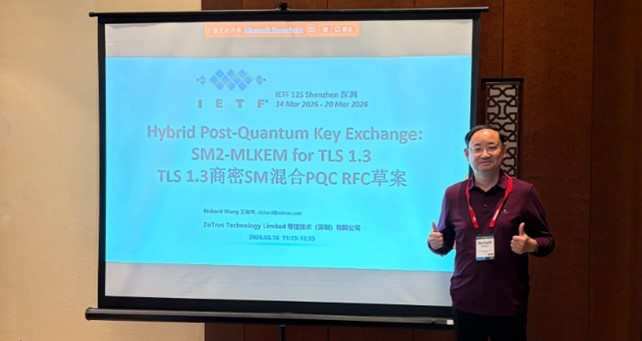
ZoTrus Drives SM2MLKEM768 RFC Draft toward International Standard at IETF 125

March 16, 2026, Shenzhen — At the 125th meeting of the Internet Engineering Task Force (IETF) currently underway in Shenzhen, Richard Wang, CEO of ZoTrus Technology, successfully hosted a side meeting focused on the transition to post quantum cryptography. The core topic was advancing a China cryptography team led hybrid cryptographic algorithm draft — the SM2 and ML KEM 768 hybrid algorithm — toward becoming an internationally recognized RFC standard.

The IETF 125 meeting opened on March 14 and is co hosted by the China Internet Network Information Center (CNNIC) together with Tsinghua University, the Internet Society of China, the China Communications Standards Association, and the Computer Network Information Center of the Chinese Academy of Sciences. It has attracted over 1,000 leading global experts and engineers in networking technology. During the seven day event, participants are engaged in more than 100 working group sessions, discussing cutting edge topics such as the integration of AI with networks, core Internet protocols, and cybersecurity. ZoTrus side meeting directly addressed the cybersecurity theme, offering concrete solutions for a quantum safe future.

During the session, Richard Wang detailed the background and progress of the draft RFC titled “Hybrid Post-quantum Key Exchange SM2-MLKEM for TLSv1.3”. He explained that the draft was created to tackle two urgent challenges: meeting China’s commercial cryptography (ShangMi) compliance requirements and countering the existential threat that quantum computing poses to current public key cryptosystems. The proposed solution combines the SM2 algorithm with the quantum resistant ML KEM 768 algorithm to form a hybrid cipher suite. A key milestone has already been reached: the Internet Assigned Numbers Authority (IANA) has assigned code point 4590 to this hybrid algorithm.

A major focus of the meeting was the ecosystem built around SM2MLKEM768, demonstrating the technical feasibility and maturity of the draft. Three representative products were highlighted:

  • Server side: Led by Alibaba, the TongsuoSSL cryptographic middleware has implemented support for the hybrid algorithm.
  • Client side: ZT Browser now natively supports the algorithm, providing users with “quantum safe” encrypted connections.
  • Enterprise side: ZoTrus HTTPS Automation Gateway provides enterprises with a convenient, automated solution for post-quantum cryptography migration deployment.

“With full stack ecosystem support — from clients and servers to enterprise products — we are ready,” said Richard Wang. “We hope to gather feedback from the community and encourage more vendors to join us in completing interoperability testing. Our goal is to advance this draft to an Experimental or Informational RFC, and ultimately to a standards track RFC.”

The side meeting received positive feedback from both onsite and online participants. One international vendor representative indicated that they would consider supporting the algorithm in the Java ecosystem and releasing an official version soon.

The discussions showcased China’s innovative strength in next generation Internet security standards and offered a feasible path for the global Internet to transition smoothly to the post quantum era while meeting compliance and security needs.

Download the Seminar PPT: https://ztbro.com/pdf/IETF125-SM2MLKEM768.pdf

ZoTrus released the world's first SM2 ACME public service